
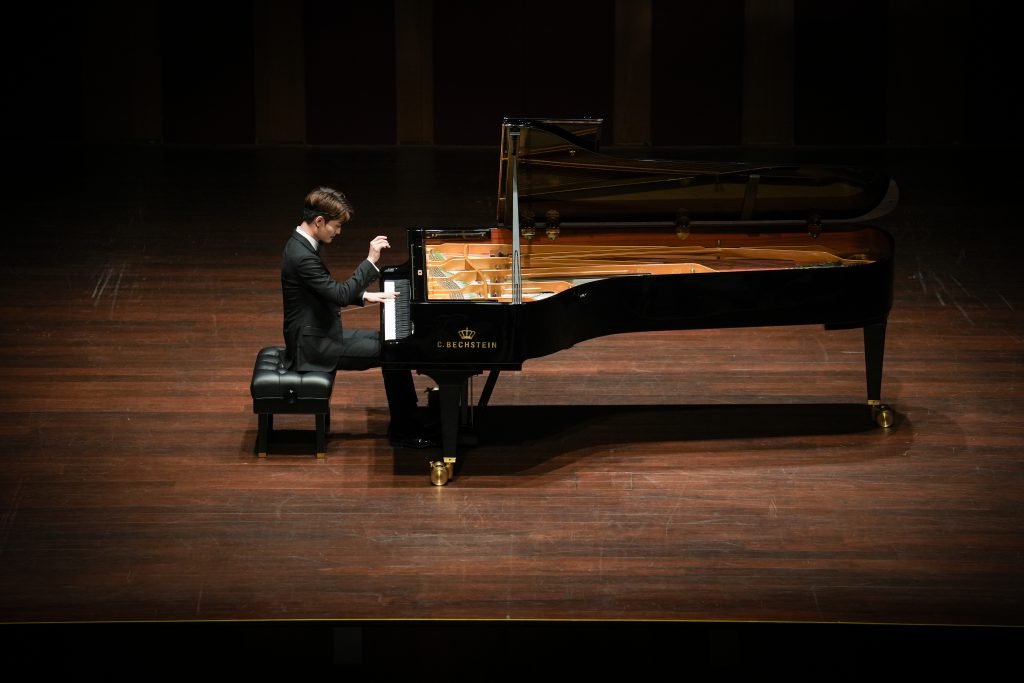
When we sit down at a modern concert grand, it is easy to take its design for granted. Eighty-eight keys, three pedals, a large soundboard, steel strings and a powerful frame may seem like an inevitable combination. But the piano we know today is the result of centuries of experimentation, musical demands and technological development.
Its story begins long before the modern piano existed — with early keyboard instruments that offered very different approaches to producing sound.
Before the Piano: The Clavichord and Harpsichord
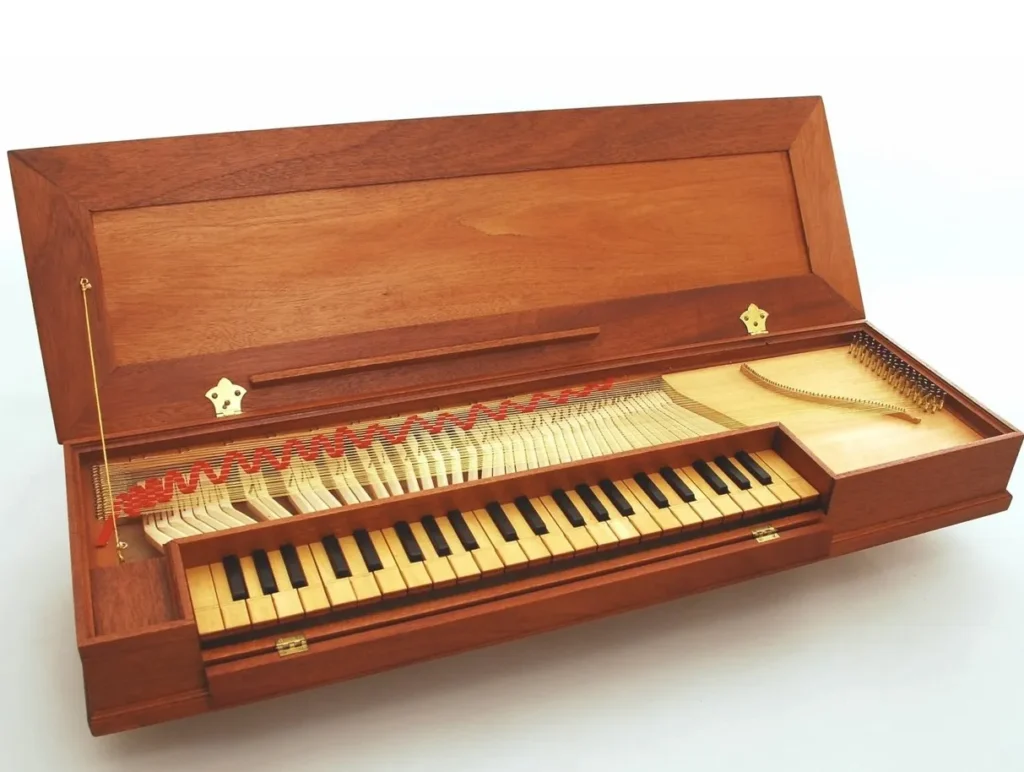
The clavichord is one of the earliest known keyboard instruments, emerging in Europe during the 14th century. Compact and quiet, it was primarily suited to private practice and intimate music-making.
Unlike the modern piano, the clavichord’s strings were struck directly by small metal tangents. This gave the player a remarkable degree of control over subtle changes in volume and expression. However, its very soft sound meant that it could not project effectively in a concert setting.
The harpsichord emerged later, during the 15th century. It became an important instrument in European courts, domestic music-making and professional ensembles. Unlike the clavichord, its strings were plucked, producing a clear and articulate sound that could project more effectively.
But the harpsichord had an important limitation: pressing a key harder did not make the note significantly louder. Its mechanism offered little dynamic control through touch.
The two instruments continued to coexist for centuries, each serving different musical purposes. Neither, however, could provide the combination of projection and dynamic control that composers and performers would eventually seek.
Cristofori and the Birth of the Piano
Around 1700, Italian instrument maker Bartolomeo Cristofori developed an entirely new approach to the keyboard.
Working in Florence for the Medici court, Cristofori replaced the harpsichord’s plucking mechanism with hammers that struck the strings. Crucially, the mechanism allowed the player to control the volume of a note according to how the key was played.
This was a fundamental change.
For the first time, a keyboard instrument could respond directly to the player’s touch with meaningful changes in dynamics. A musician could play softly or loudly without changing instruments or using a separate mechanism.
Cristofori called his invention the gravicembalo col piano e forte, meaning roughly “harpsichord with soft and loud.” The name was later shortened to pianoforte and eventually piano.
Only three of Cristofori’s original pianos survive today, providing an extraordinary link to the instrument’s beginnings.
From Cristofori’s Piano to the Fortepiano
Cristofori’s invention did not immediately become the modern piano. Instead, his hammer-action principle was developed by instrument makers across Europe.
During the 18th century, the fortepiano evolved into a lighter and more delicate instrument than today’s concert grand. Its sound was generally shorter and less powerful, with a distinctive contrast between registers and a wide range of tonal colours.
It became the keyboard instrument of composers such as Joseph Haydn, Wolfgang Amadeus Mozart and Ludwig van Beethoven.
For these composers, the fortepiano offered something the harpsichord could not: a direct relationship between the performer’s touch and the instrument’s dynamics.
But music was changing.
Composers were writing increasingly ambitious works, performers were developing new techniques, and public concerts were becoming increasingly important. The piano would have to develop alongside them.
The 19th Century: Engineering Changes the Piano
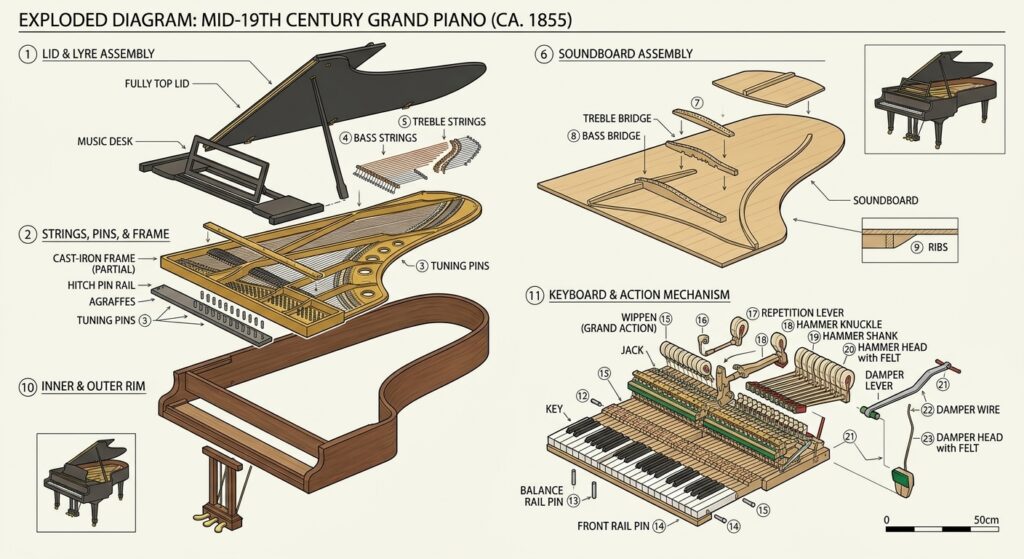
The 19th century was a period of enormous change in piano construction.
One of the most important developments was the increasing use of iron reinforcement and cast-iron frames. Stronger structures allowed pianos to withstand greater string tension, making it possible to build larger and more powerful instruments.
The development of steel strings also contributed to greater tension, projection and sustain.
Another important innovation was overstringing, in which the bass strings cross diagonally over the upper strings. This allowed makers to use longer bass strings within a practical-sized instrument, contributing to a fuller and more resonant bass.
These developments did not happen all at once, nor were they the work of a single inventor. Piano makers across Europe experimented with different combinations of materials and construction techniques throughout the century.
Together, however, these innovations transformed the piano.
The relatively light fortepiano gradually developed into a much larger and more powerful instrument capable of filling increasingly large concert spaces.
When Composers Began Pushing the Instrument
The evolution of the piano was closely connected to the changing expectations of performers and composers.
Few musicians demonstrated this more dramatically than Franz Liszt.
Liszt’s playing demanded enormous power, range and technical capability from the instruments of his time. His performances helped expose the limitations of many contemporary pianos, while the growth of the public concert also created demand for instruments that could project across much larger halls.
This created a productive relationship between musicians and makers.
Composers and performers demanded more from the piano. Piano makers responded with stronger frames, improved actions, larger soundboards and greater range. The instrument, in turn, allowed musicians to imagine new possibilities.
The piano was no longer simply a household or chamber instrument. It was becoming a major concert instrument.
The Rise of the European Piano Makers
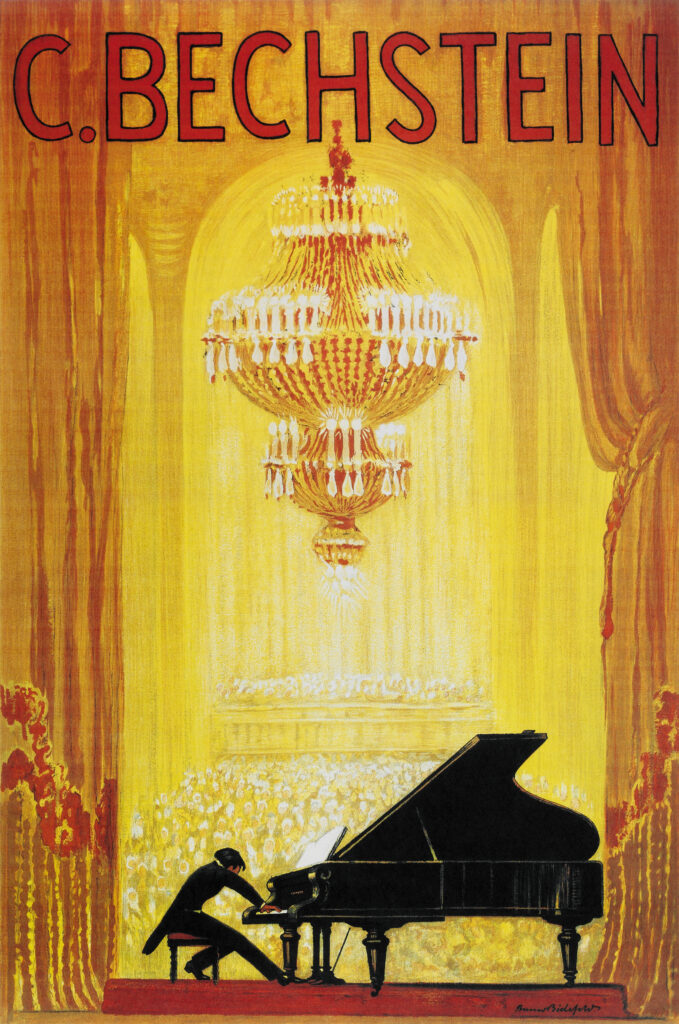
The 19th century also saw the emergence of many of the European piano manufacturers whose names remain familiar today.
In Berlin, Carl Bechstein founded his piano company in 1853, becoming part of a new generation of European makers developing instruments for the demands of the modern concert stage.
Other major makers, including Blüthner in Leipzig and Bösendorfer in Vienna, also established their reputations during this period.
Each developed its own approaches to construction and tonal design. While the basic principles of the piano were becoming increasingly standardised, makers continued to pursue different ideas about projection, resonance, tonal colour and touch.
This is one reason why European pianos can possess such distinctive characteristics even when they share broadly similar construction.
The Modern Concert Grand Emerges
By the late 19th century, many of the essential features associated with the modern concert grand had been established.
The instrument had grown considerably in size and range. Stronger framing allowed higher string tension, while steel strings, improved soundboards and overstringing contributed to greater volume and resonance. Felt-covered hammers also allowed increasingly refined control over tone.
The familiar 88-key keyboard became the standard for the modern concert piano, although the transition to this configuration took place gradually rather than at a single point in history.
The result was an instrument capable of producing an extraordinary range of sound — from delicate pianissimo to powerful orchestral projection.
This was the piano required by the great composers of the Romantic era. Works by Chopin, Liszt, Brahms, Tchaikovsky and Rachmaninoff demanded an instrument capable of handling expansive textures, wide registers and increasingly complex musical expression.
The concert grand had become not simply a larger piano, but an essential part of the musical language of its time.
From the Concert Hall to Today
Modern concert grands continue to benefit from the innovations developed throughout the 19th and 20th centuries. At the same time, piano makers continue to refine materials, manufacturing techniques, action design, soundboard construction and tonal characteristics.
Yet the fundamental principle introduced by Cristofori remains remarkably relevant.
The player presses a key, the mechanism responds, and the hammer strikes the string. The performer can shape the sound through touch — controlling dynamics, articulation and expression.
After centuries of evolution, the piano remains one of the most versatile instruments in Western music.
From the intimate clavichord to the powerful concert grand, its development reflects a continuous dialogue between musicians, composers, craftsmen and technology.
And that evolution is still continuing today.
The European Sound
For students learning the piano today, every lesson takes place at the end of this remarkable history. The instrument may look familiar, but behind those 88 keys are centuries of experimentation and craftsmanship.
Understanding where the piano came from can also deepen our appreciation of what it allows us to do today — whether we are playing a Mozart sonata, a Chopin nocturne, a contemporary composition, or simply discovering our own musical voice.
The concert grand is not the end of the piano’s story. It is the latest chapter in an evolution that continues to shape how we make and experience music.
Explore the world of European Sound Pianos at the Bechstein Music World, located at 7 Shenton Way, #02-01 Singapore Conference Hall (S068810)