

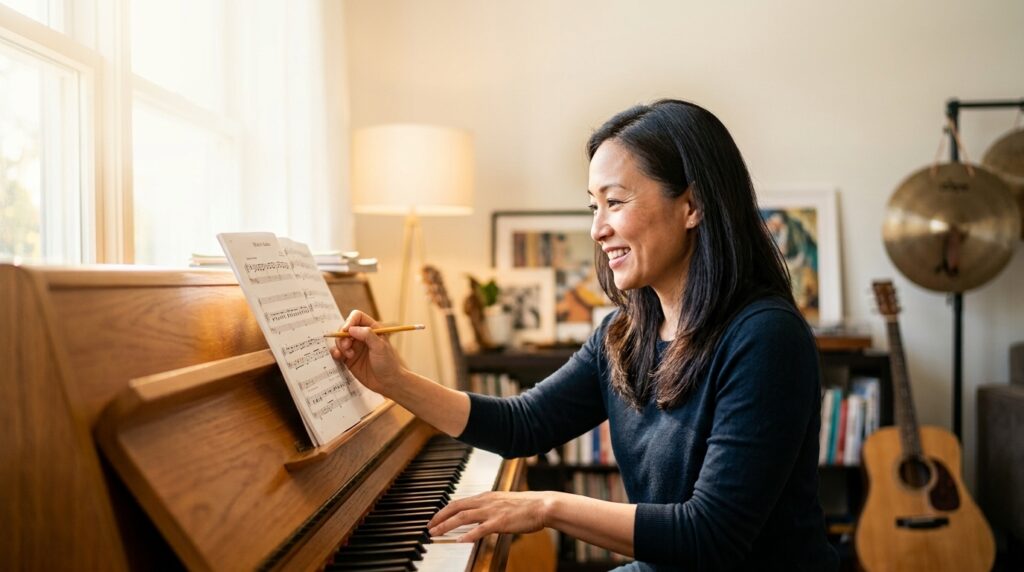
There’s a common belief that music is something you have to start young to ever get good at. That if you didn’t have piano lessons at age five or pick up a guitar in your teens, the window has somehow closed. It hasn’t. In fact, learning music as an adult comes with a unique set of advantages — and a growing body of research to back them up.
Whether you’ve never touched an instrument in your life, or you used to play and let it slip away somewhere between university and a full-time job, there has never been a better time to start (or start again).
Your Brain Will Thank You

One of the most well-documented benefits of learning music is what it does for your brain. Playing an instrument engages multiple areas of the brain simultaneously — motor control, auditory processing, memory, and emotional response all activate at once. For adults, this kind of full-brain engagement has been linked to sharper memory, improved concentration, and even a reduced risk of cognitive decline later in life.
Unlike passively listening to music, actively playing it requires your brain to constantly adapt and problem-solve. Reading notation, coordinating your hands, listening to yourself in real time, and adjusting — all of this happens in the span of a single bar. It’s a mental workout that few other hobbies can match.
It’s One of the Most Effective Stress Relievers You’ll Find
Most adults don’t need to be told that life is busy. Work pressures, family commitments, and the constant pull of screens leave little room for genuine mental rest. Music offers something rare: an activity that demands your full attention in a way that actually feels good.
When you’re focused on playing — whether that’s nailing a chord transition, keeping time, or getting through a piece from start to finish — there’s little headspace left for the usual mental noise. Many adult learners describe their practice sessions as the one part of the day where everything else falls away. That’s not a coincidence. Playing music has been shown to lower cortisol levels and trigger the release of dopamine, the brain’s feel-good chemical.
Adults Are Often Better Students Than They Think
Here’s something music teachers will tell you: adult learners are frequently more motivated, more focused, and more self-aware than younger students. You’re choosing to be there. You understand the value of practice. You can contextualise feedback and apply it deliberately in a way that children often can’t.
Adults also bring life experience to their playing. Emotion, nuance, and musical interpretation often come more naturally because you’ve lived more — and music is ultimately a form of expression.
The main challenge for adult learners isn’t ability. It’s patience with themselves. Progress on an instrument is rarely linear, and adults can be harder on themselves than necessary. The key is to measure your growth in weeks and months, not days.
It Opens Up a Social World You Might Not Expect

Music is rarely a solitary pursuit for long. Once you reach a certain level of comfort with an instrument, opportunities to connect with others open up — ensemble classes, group workshops, jam sessions, or simply playing for friends and family. For many adults, this social dimension becomes one of the most rewarding parts of the journey.
There’s also something uniquely bonding about making music with other people. It requires listening, responding, and adapting in real time — skills that translate well beyond the music room.
You Can Set Your Own Goals
One of the biggest differences between learning music as an adult versus as a child is autonomy. You get to decide what success looks like. Maybe it’s learning to play a handful of songs you love. Maybe it’s working toward a formal qualification like an RSL grade exam. Maybe it’s simply having something that’s entirely yours — a skill developed for its own sake, with no deadlines or expectations attached.
Formal graded examinations are available for adults at every level and can provide useful milestones and a sense of structured achievement if that’s what motivates you. But they’re entirely optional. The beauty of adult learning is that you’re in the driver’s seat.
Starting (or Starting Again) Is Easier Than Ever
Structured music lessons for adults are widely available, taught by experienced teachers who understand the specific needs and learning styles of grown-up students. Many schools offer flexible scheduling around working hours, and lesson formats range from one-to-one tuition to small group classes depending on your preference.
If you played as a child and are returning to an instrument, you may be surprised how quickly it comes back. Muscle memory is remarkably resilient, and the foundational understanding you built years ago doesn’t disappear — it simply needs to be reawakened.
And if you’re a complete beginner? You’re in good company. Many of the most enthusiastic adult learners have never played a note before walking into their first lesson. The only real requirement is curiosity and a willingness to show up.
The Best Time to Start Is Now
There will always be a reason to put it off — the schedule is too full, the timing isn’t right, you’ll get to it eventually. But music rewards consistency over time, and the sooner you begin, the sooner you’ll experience what so many adult learners describe as one of the most fulfilling decisions they’ve ever made.
Pick the instrument that calls to you. Find a teacher who gets it. And give yourself permission to be a beginner.
You might just surprise yourself.
Interested in starting your musical journey? Lessons are available for adults across a wide range of instruments and levels. Get in touch with us to find out more about scheduling, programmes, and what’s right for you!